
Why Did My Florida Trucking Insurance Double? The 2026 Math Behind Your Renewal
By Ricardo Alonso, Founder, Atesa Risk Advisors · June 10, 2026 · Updated September 27, 2026
Key Takeaways
- U.S. commercial auto insurance has posted an underwriting loss for 14 consecutive years, ending 2024 with a 107.2 combined ratio — carriers paid out more than they collected, again [1]
- Nuclear verdicts (jury awards of $10 million or more) hit $31.3 billion in 2024, up 116% in one year [2]. Florida historically ranks among the top states, though it fell to No. 10 in 2024 after the 2023 tort reform
- Small fleets pay the most per truck: carriers with 25 or fewer trucks paid 20.3 cents per mile for liability coverage in 2024 — nearly double what mid-size fleets pay [3]
- Renewal premiums were still climbing roughly 7% per year into late 2025, per the industry's renewal-rate benchmark [4]
- Underwriters price your trucks off your public FMCSA safety profile — safety rating, out-of-service rates, crash history, insurance filing lapses. Most fleet owners have never seen theirs. Check yours free in 60 seconds
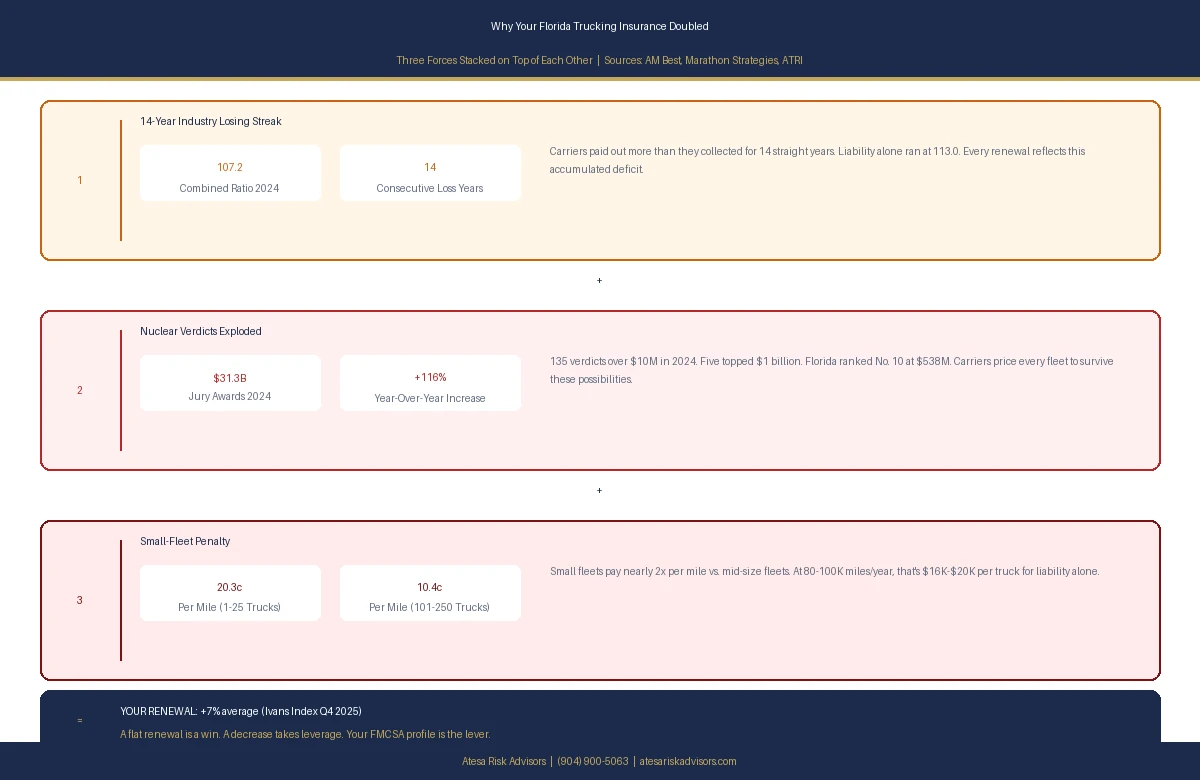
If your Florida trucking insurance doubled, it wasn't one thing — it was three stacked on top of each other: an industry that has lost money on commercial auto for 14 straight years [1], lawsuit verdicts that more than doubled in a single year [2], and a small-fleet penalty that has carriers charging 1-to-25-truck operations nearly twice as much per mile as bigger fleets [3]. The bad news: you can't fix the market. The good news: the part of your premium that's specific to your fleet is sitting in a public federal database, and most of it is fixable.
This guide walks through the verified numbers behind the increases, what underwriters actually look at when your application lands on their desk, and the renewal playbook that separates the fleets that get priced from the fleets that get declined.
The 14-Year Losing Streak Driving Every Renewal
Insurance companies measure profitability with something called a combined ratio — claims plus expenses, divided by the premium they collected. Below 100 means profit. Above 100 means they lost money writing that line of business.
Commercial auto's combined ratio came in at 107.2 in 2024. That made it the 14th consecutive year the segment lost money for U.S. insurers, according to AM Best, the rating agency that grades insurance companies [1]. The commercial auto liability piece alone — the part that pays injury claims — ran at 113.0.
Sit with that for a second: for fourteen years, the industry as a whole has paid out more on commercial auto than it took in. Carriers respond to that the only ways they can — raising rates, tightening who they'll cover, and walking away from risks they would have written five years ago. When your renewal comes back up 15% with no claims on your record, this is the engine under the hood.
Nuclear Verdicts: The $31 Billion Reason Carriers Are Scared
A nuclear verdict is a jury award of $10 million or more. In 2024, U.S. juries handed down a record 135 of them against corporate defendants, totaling $31.3 billion — up 116% from $14.5 billion the year before, according to Marathon Strategies' annual tracking report [2]. Forty-nine of those verdicts topped $100 million; five topped $1 billion.
Trucking lives at the center of this. A single catastrophic crash involving a commercial truck can produce a verdict that erases decades of premium from an entire state. Carriers price every fleet — including clean ones — to survive that possibility.
The Florida wrinkle: Florida built its reputation as one of the most dangerous states in the country to insure a truck, and Marathon lists it among the states with the largest cumulative verdict totals since 2009, alongside Texas, California, and Pennsylvania [2]. But Florida's 2023 tort reform (House Bill 837, which shortened the window to file negligence suits and changed how fault is split) is showing up in the data — the state fell to No. 10 in 2024 at $538 million. That's genuine progress, and it's part of why some carriers are warming back up to Florida risks. It is not, however, a return to cheap: the national verdict trend swamps the state-level improvement, and carriers price nationally.
What Small Fleets Actually Pay — and Why Size Works Against You
The American Transportation Research Institute (ATRI) tracks what motor carriers actually spend on insurance, and its 2026 study puts hard numbers on what every owner-operator already feels [3]:
| Fleet size | Liability premium per mile (2024) | What that means |
|---|---|---|
| 5–25 trucks | 20.3¢/mile | ≈ $16,000–$20,000/truck/year at 80,000–100,000 miles — liability only |
| 26–100 trucks | 16.1¢/mile | Premiums up 50.5% for this band since 2020 |
| 101–250 trucks | 10.4¢/mile | Roughly half the small-fleet rate |
| Industry average | 10.2¢/mile | A record high — up 18.6% since 2021 |
Two things to notice. First, those figures are liability only — before physical damage on the truck, cargo coverage, bobtail, or occupational accident. A full small-fleet program costs meaningfully more than the liability line alone. Second, the per-mile premium rose 18.6% from 2021 to 2024 while truck crash rates actually fell 2.6% [3]. Safer roads, higher premiums — that's the nuclear-verdict math passing through to your bill.
And the increases haven't stopped: the Ivans Index, the insurance industry's benchmark for renewal pricing, showed commercial auto renewals still rising about 7% year-over-year at the end of 2025 [4]. In this market, a flat renewal is a win. A decrease takes leverage.
You're Priced Off Your Public Record
Here's what most fleet owners don't know: before any underwriter reads your application, they pull your USDOT number and read your public FMCSA profile. That profile — not your story, not your loyalty, not your agent's relationship — sets the tone for your pricing. It includes:
- Your federal safety rating — Satisfactory, Conditional, or Unsatisfactory. A Conditional rating is, by itself, often the single biggest premium driver on a distressed account. Many carriers decline Conditional fleets outright.
- Your out-of-service rates — when roadside inspectors put your truck or driver out of service, it's recorded and compared against national averages. A high vehicle rate reads as deferred maintenance; a high driver rate reads as hours-of-service and licensing problems.
- Your 24-month crash history — normalized against your fleet size. For a 1–10 truck fleet, frequency is priced harder than severity.
- Your insurance filing history — federal liability filings (and any lapses) live on your authority record. A lapse-revocation event follows your DOT number for years.
- Your authority age — carriers surcharge authorities under about two years old. The "new venture" penalty fades only as your public track record builds.
Every one of those items is public, and every one is either fixable or manageable — but only if you see it before the underwriter does. That's exactly why we built the free DOT Risk Scorecard: enter your USDOT number and get a letter-grade read of your profile — the same data, graded the way an underwriter reads it — in about 60 seconds.
What Federal Law Requires (and Why Shippers Demand More)
Federal regulation sets the floor for interstate trucking liability coverage [5]:
| Cargo type | Federal minimum liability |
|---|---|
| General freight (vehicles over 10,000 lbs) | $750,000 |
| Oil and certain hazardous substances | $1,000,000 |
| Other hazardous materials (incl. large cargo tanks) | $5,000,000 |
Treat those as the floor, not the target. Most freight brokers and shippers contractually require $1 million in liability before they'll tender a load, and many also demand $100,000 in cargo coverage. Running at the bare federal minimum doesn't just expose your business to a verdict — it shrinks the freight you're allowed to haul.
The Jacksonville Angle: Port Freight Keeps Growing
If you run drayage, reefer, or intermodal work out of Northeast Florida, your market is expanding underneath you: cargo activity through Jacksonville's seaport supported more than 258,800 Florida jobs and $44 billion in annual economic output in 2024, according to a Martin Associates study published by JAXPORT [6]. More port freight means more trucks, more competition for loads — and more carriers scrutinizing the safety profiles of the fleets that serve the port.
For port-serving fleets, insurance is a dispatch issue, not just a cost issue: brokers check your coverage and your safety record before they tender. A clean, documented profile wins loads, not just lower premiums.
I've sat on both sides of this table. Before I was a broker, I ran construction crews and trucks, and I learned the hard way that the carrier's first look at you isn't your application — it's your public record. The fleets that win renewals treat their FMCSA profile like a credit score: they check it, they fix it, and they make carriers compete on the improved version. That's the entire playbook.
— Ricardo Alonso, Founder, Atesa Risk Advisors
Your 5-Step Renewal Timeline
| When | What to do |
|---|---|
| 120 days out | Pull your free DOT Risk Scorecard and your loss runs. Identify every flag an underwriter will see. |
| 90 days out | Fix the fixable: file overdue MCS-150 updates, challenge incorrect violations through FMCSA's DataQs system, document your maintenance program. |
| 60–75 days out | Get your submission package together: loss runs, driver list with MVRs, equipment list with values, payroll/mileage by state. A complete package gets quoted first and priced best. |
| 45 days out | Have an independent broker shop the full program — liability, physical damage, cargo, bobtail — across standard and trucking-specialty markets. The spread on identical risks routinely exceeds 25%. |
| 30 days out | Bind, confirm your federal filings went through, and collect certificates. Never let coverage lapse into the renewal date — a lapse on your authority record costs you for years. |
FAQ for Florida Fleet Owners
Q: Why did my premium jump when I've never filed a claim?
A: Because most of your premium is market, not you. Carriers lost money on commercial auto for 14 straight years [1] and nuclear verdicts hit $31.3 billion in 2024 [2], so rates rise across the board — about 7% a year recently [4]. The remainder is your public FMCSA profile: out-of-service violations, crash records, authority age, and filing history add fleet-specific surcharge even with zero claims.
Q: How much should a small Florida fleet expect to pay?
A: ATRI's data puts fleets of 25 or fewer trucks at 20.3 cents per mile for liability in 2024 — roughly $16,000–$20,000 per truck per year at typical mileage, before physical damage and cargo [3]. Where you land in (or below) that range depends heavily on your safety profile, radius, and cargo.
Q: What is a combined ratio and why should I care?
A: It's the industry's profit gauge: claims plus expenses divided by premium. Commercial auto's was 107.2 in 2024 — a loss — for the 14th year running [1]. You should care because unprofitable carriers raise rates, non-renew more freely, and decline marginal profiles. It explains why "loyalty" doesn't protect your renewal.
Q: Did Florida's tort reform actually lower trucking insurance costs?
A: It's helping at the margins. HB 837 (2023) shortened lawsuit windows and changed fault rules, and Florida's nuclear-verdict total fell to No. 10 nationally in 2024 [2]. But carriers price against the national verdict environment, which more than doubled the same year — so the reform slowed Florida's increases rather than reversing them.
Q: What do underwriters see when they pull my DOT number?
A: Your federal safety rating, vehicle and driver out-of-service rates versus national averages, 24-month crash history, fleet size, authority age, and your liability insurance filings — including lapses. All of it is public. Our DOT Risk Scorecard shows you the same data, graded, free.
Q: Is the federal minimum of $750,000 enough liability coverage?
A: Legally, yes, for general freight [5]. Practically, no: most brokers and shippers require $1 million before tendering loads, and a single serious injury claim can blow through $750,000. The step from $750K to $1M usually costs far less than the freight access it unlocks.
Q: Can I get coverage with a Conditional safety rating or a new authority?
A: Usually, yes — through trucking-specialty markets rather than standard carriers, at a surcharge. The better play is parallel: place coverage in the right market now, and work the upgrade petition (or build the new-authority track record) so next renewal prices off a better profile.
Related Reading
- FMCSA Is Recalculating Your Fleet's Safety Score: The 2026 Overhaul — the safety-score playbook that claws renewal pricing back, plus the free DOT Scorecard.
- Florida Contractor Insurance Bundle: The Complete 2026 Guide — GL, workers' comp, tools, and commercial auto for construction operations
- Florida Commercial Insurance Rates: The 2026 Business Guide — where every commercial line is heading this year
- Florida Marine Cargo Insurance in 2026: Warehouse Legal Liability, the FOB Gap, and Why the Carrier's Limit Isn't Coverage — coverage for the freight itself and for goods in a warehouse.
- Florida EV Commercial Fleet Insurance 2026: The Saltwater Battery-Fire Gap Standard Auto Policies Miss — the battery and saltwater exposures an electric fleet adds.
How Atesa Risk Advisors Can Help
We built our trucking practice around the fleets the national brokerages ignore: 1–10 trucks, owner-operators, and port-serving operations on the Florida–Georgia–South Carolina corridor. We don't just shop your renewal across 40+ appointed carriers, including trucking-specialty markets that never sell direct — we start with the reason you're expensive. Your free DOT Risk Scorecard shows your fleet the way underwriters see it, we build the fix-it plan, and then we make carriers compete on the improved profile. Same-day certificates, federal filings handled, plain answers.
Ready to see what underwriters see? Run your free DOT Risk Scorecard, get your free quote at atesariskadvisors.com/get-quote, or call (904) 900-5063.
Sources
[2] Marathon Strategies — Corporate Verdicts Go Thermonuclear: 2025 Edition
[3] American Transportation Research Institute — Trucking's Rising Insurance Costs (May 2026)
[4] Ivans Index — Q4 and Year-End 2025 Results (Applied Systems, January 2026)
[5] 49 CFR § 387.9 — Financial responsibility, minimum levels (eCFR, current)
[6] JAXPORT — Economic Impact (Martin Associates study, 2024 data)
External Resources for Fleet Owners:
- FMCSA SAFER Company Snapshot — your public carrier record
- FMCSA DataQs — challenge incorrect violations on your record
- Atesa DOT Risk Scorecard — your profile, graded the way underwriters read it
Ricardo Alonso is the Founder of Atesa Risk Advisors, a Florida independent insurance agency. A Licensed 2-20 General Lines Agent with a Master of Liberal Arts in Finance from Harvard University and a background running construction crews and trucks, he helps owner-operators and small fleets across the FL/GA/SC corridor fix the risk profiles that price their renewals.