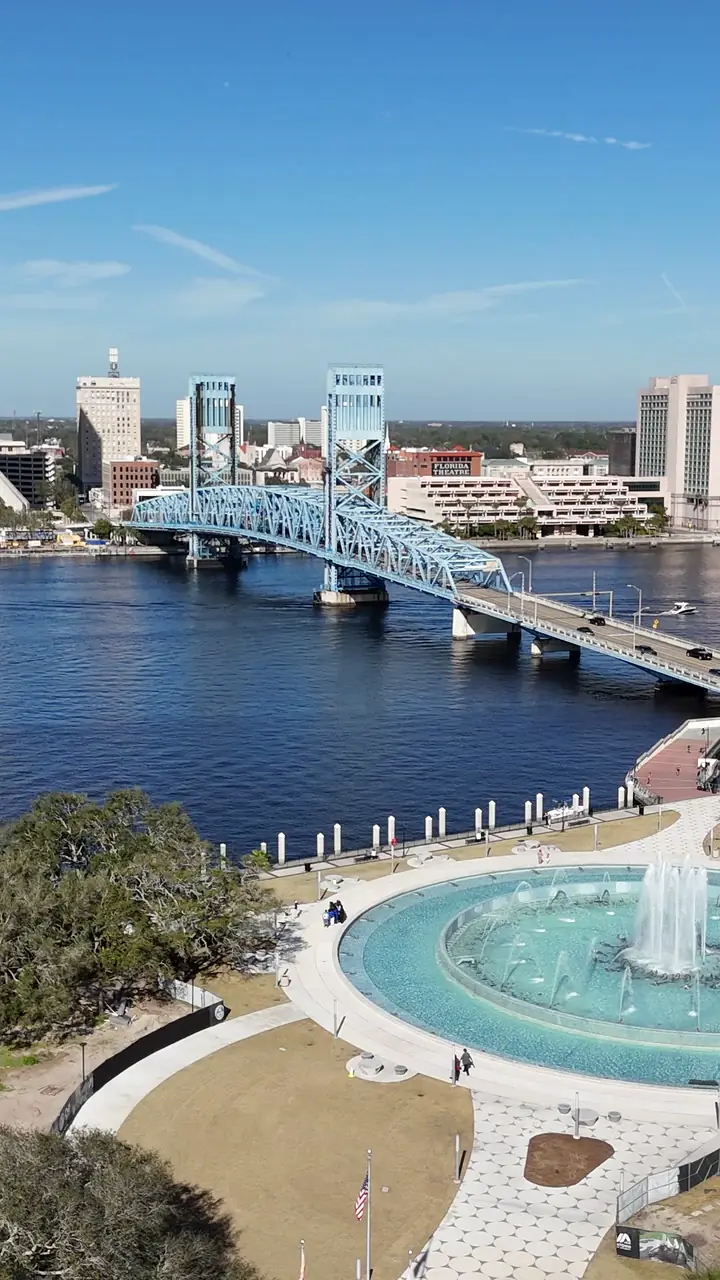
Flood Insurance in Jacksonville, St. Augustine and Northeast Florida
Flood insurance is a separate policy: a federal (NFIP) policy pays up to $250,000 for a home and $100,000 for its contents, typically after a 30-day wait, and private flood fills the gap above those caps. Jacksonville's CRS Class 6 earns a 20% discount on every federal policy, and St. Augustine's Class 4 earns 30%.
NFIP and private flood insurance for Jacksonville and St. Augustine: CRS discounts by city, the $250,000 cap, Irma and Matthew history. Don't wait for a storm.
Figures reviewed against Florida Statutes and carrier bulletins on September 27, 2026.
Flood insurance in Jacksonville and St. Augustine
Northeast Florida floods from three directions: the St. Johns River, the Intracoastal and the Atlantic. The federal program prices the same house differently depending on which city limits it sits inside.
Jacksonville and the St. Johns River
On September 11, 2017 the St. Johns crested at an all-time record 5.57 feet NAVD88 at Main Street during Irma, beating Dora's 1964 record of 4.12 feet, with about 350 water rescues in Riverside, San Marco and downtown; the National Weather Service credits a nor'easter setup, high astronomical tides, river surge and rainfall combined, not a Northeast Florida landfall.
- A federal (NFIP) policy pays up to $250,000 for a home's building and $100,000 for its contents, and up to $500,000 each for a non-residential building and its contents; private flood carriers write the limits above those caps and the loss-of-use coverage the federal form does not include.
- Jacksonville, Jacksonville Beach and Neptune Beach hold FEMA Community Rating System Class 6, a 20% discount that under Risk Rating 2.0 applies to every federal policy in the community, including homes outside the mapped high-risk zone; Atlantic Beach moves to Class 5 (25%) on October 1, 2026; unincorporated Clay County, including Fleming Island, is Class 6 as well, while Orange Park, Green Cove Springs, Callahan, Hilliard and Bunnell earn no CRS discount.
- Federal policies typically carry a 30-day waiting period, with exceptions for coverage bought in connection with a loan closing and for certain flood-map changes (FEMA); Matthew's surge in October 2016 knocked out power for nearly 250,000 Jacksonville-area customers and set a then-record 3.28 feet above mean higher high water at Mayport, and Nicole put 3.82 feet on the river at the Buckman Bridge in November 2022.
St. Augustine and the coast
Matthew produced 5 to 7 feet of inundation along the Flagler, St. Johns and Duval coasts in October 2016, put up to 4 feet of water in the city of St. Augustine and more than 2 feet across Anastasia Island, and washed out A1A along Flagler County; Nicole brought inundation of up to 5 feet along the Northeast Florida coast in November 2022.
- The city of St. Augustine moved to CRS Class 4 on April 1, 2026, a 30% discount on federal flood premiums; unincorporated St. Johns County, including Ponte Vedra Beach and Nocatee, is Class 5 (25%); St. Augustine Beach is Class 8 (10%); Fernandina Beach is Class 5 and Nassau County Class 7; Palm Coast is Class 4 and Flagler County Class 6.
- The city says tidal flooding reaches its low-lying streets 12 to 16 times a year, and the Avenida Menendez seawall rehabilitation is expected to be complete by October 31, 2026; the discount and the projects lower the premium, they do not lower the water.
- Property insurance claims in Florida, flood included on a private policy, must be reported within one year of the date of loss and supplemental claims within 18 months, with a hurricane's date of loss set at landfall (FS 627.70132); the federal program has its own proof-of-loss deadlines, and we calendar both at binding.
Flood-program (CRS) class and federal flood discount by community, Northeast Florida
| Community | CRS class → NFIP discount | Class in effect since |
|---|---|---|
| Jacksonville (Duval) | Class 6 → 20% | May 2010 |
| Jacksonville Beach | Class 6 → 20% | May 2013 |
| Atlantic Beach | Class 5 → 25% (Class 6 → 20% before October 1, 2026) | October 2026 |
| Neptune Beach | Class 6 → 20% | October 2024 |
| Clay County (unincorporated, incl. Fleming Island) | Class 6 → 20% | October 2023 |
| St. Johns County (unincorporated, incl. Ponte Vedra and Nocatee) | Class 5 → 25% | May 2016 |
| St. Augustine | Class 4 → 30% | April 2026 |
| St. Augustine Beach | Class 8 → 10% | May 2008 |
| Nassau County (unincorporated) | Class 7 → 15% | April 2023 |
| Fernandina Beach | Class 5 → 25% | October 2024 |
| Flagler County (unincorporated) | Class 6 → 20% | October 2016 |
| Palm Coast | Class 4 → 30% | May 2017 |
Classes and effective dates from FEMA's NFIP community status data, read September 27, 2026. Orange Park, Green Cove Springs, Keystone Heights, Callahan, Hilliard, Bunnell and Baldwin do not participate in CRS. Under Risk Rating 2.0 the discount applies to every NFIP policy in the community, not only high-risk zones.
Guides
- Jacksonville Flood Insurance After Tropical Storm Arthur: The St. Johns River Surge Gap in San Marco, Riverside, and Brooklyn (2026)
- Do You Need Flood Insurance for a New Home in St. Johns County? The 2026 Nocatee, SilverLeaf & RiverTown Buyer's Guide
- Amelia Island Flood Insurance in 2026: The Nassau County CRS Discount That Can Cut Your Premium 15–25%
- Private Flood Insurance vs. NFIP in Florida (2026): The September 30 Deadline, Risk Rating 2.0, and the $250,000 Gap
Data sources
- FEMA / FloodSmart, What's covered (NFIP coverage limits)
- FEMA / NFIP, coverage limits
- FEMA, Flood insurance: purchase requirements and the 30-day waiting period (updated Jan. 2, 2026)
- FEMA, Community Rating System (discount schedule; updated April 8, 2026)
- FEMA, NFIP Community Status Book (Community Rating System classes)
- National Weather Service Jacksonville, Hurricane Irma post-storm summary
- National Hurricane Center, Tropical Cyclone Report: Hurricane Matthew (AL142016)
- National Hurricane Center, Tropical Cyclone Report: Hurricane Nicole (AL172022)
- City of St. Augustine, City-Wide Tide Check Valves (tidal flooding frequency)
- City of St. Augustine, Avenida Menendez seawall rehabilitation update (April 7, 2026)
- Florida Statutes § 627.70132 (notice of property insurance claim)
Frequently Asked Questions
How much is the flood insurance discount in Jacksonville versus St. Augustine?
Jacksonville holds FEMA Community Rating System Class 6, a 20% discount on federal flood premiums, and the city of St. Augustine moved to Class 4 on April 1, 2026, a 30% discount. It depends on the community, not the county: unincorporated St. Johns County is Class 5 (25%) and St. Augustine Beach Class 8 (10%).
Which Northeast Florida communities get a flood insurance discount, and which get none?
Jacksonville, Jacksonville Beach and Neptune Beach hold FEMA Community Rating System Class 6, a 20% discount on federal flood premiums, and Atlantic Beach moves to Class 5 (25%) on October 1, 2026. Orange Park, Green Cove Springs, Callahan, Hilliard and Bunnell do not participate. Under Risk Rating 2.0 the discount applies to every federal policy in the community.
Do I need flood insurance in Jacksonville if my home is not in a flood zone?
A homeowners policy excludes rising water, and a federal flood policy on a home outside the mapped high-risk zone still gets Jacksonville's full 20% CRS discount. The St. Johns River's all-time record crest, 5.57 feet at Main Street on September 11, 2017, flooded streets in Riverside, San Marco and downtown that many owners assumed were safe.
Do I need flood insurance if I'm not in a high-risk flood zone?
Yes, you should still consider it. FEMA reports that almost one-third of NFIP flood insurance claims come from outside high-risk flood areas. A federal policy outside the high-risk zone still earns the community's full CRS discount (20% in Jacksonville, 30% in St. Augustine). The homeowners policy excludes rising water.
What's the difference between NFIP and private flood insurance?
NFIP (National Flood Insurance Program) is government-backed with standard rates and coverage limits ($250,000 building, $100,000 contents). Private flood insurance offers higher limits (up to $5 million+), replacement cost coverage (vs. actual cash value), broader coverage (pools, detached structures), and sometimes lower premiums. Private insurers can also cover properties NFIP won't insure.
When does flood insurance coverage begin?
Federal (NFIP) coverage typically begins after a 30-day waiting period. FEMA's exceptions include coverage bought in connection with a loan closing and coverage tied to certain flood-map changes. Private flood insurers set their own waiting periods, often shorter. A policy purchased after a storm is named will not respond to that storm if the waiting period has not run.
Does flood insurance cover my basement and belongings stored there?
NFIP has very limited basement coverage. It covers structural elements (foundation, stairs, electrical/plumbing systems) but not finished living space, personal belongings, or furniture in basements. Private flood policies may offer broader basement coverage. If you store valuables in your basement, consider private flood insurance or move items to higher floors.
How are flood insurance premiums calculated?
Under Risk Rating 2.0, NFIP premiums are built from the specific property: distance to water and flood sources, elevation and first-floor height, flood frequency, foundation and building type, replacement cost and the coverage amount, with the community's CRS discount applied to every policy. Private insurers use their own models and may price the same home differently, in either direction.
Related Guides
- Jacksonville riverfront flood insurance: the St. Johns surge gap
- Flood insurance for new homes in St. Johns County
- Private flood insurance vs. NFIP in Florida
- Clay County's new FEMA flood zone map (anticipated spring 2027)
- Excess flood for high-value coastal homes above the NFIP cap
Get a free quote or call (904) 900-5063 — Atesa Risk Advisors, independent Florida insurance brokerage.