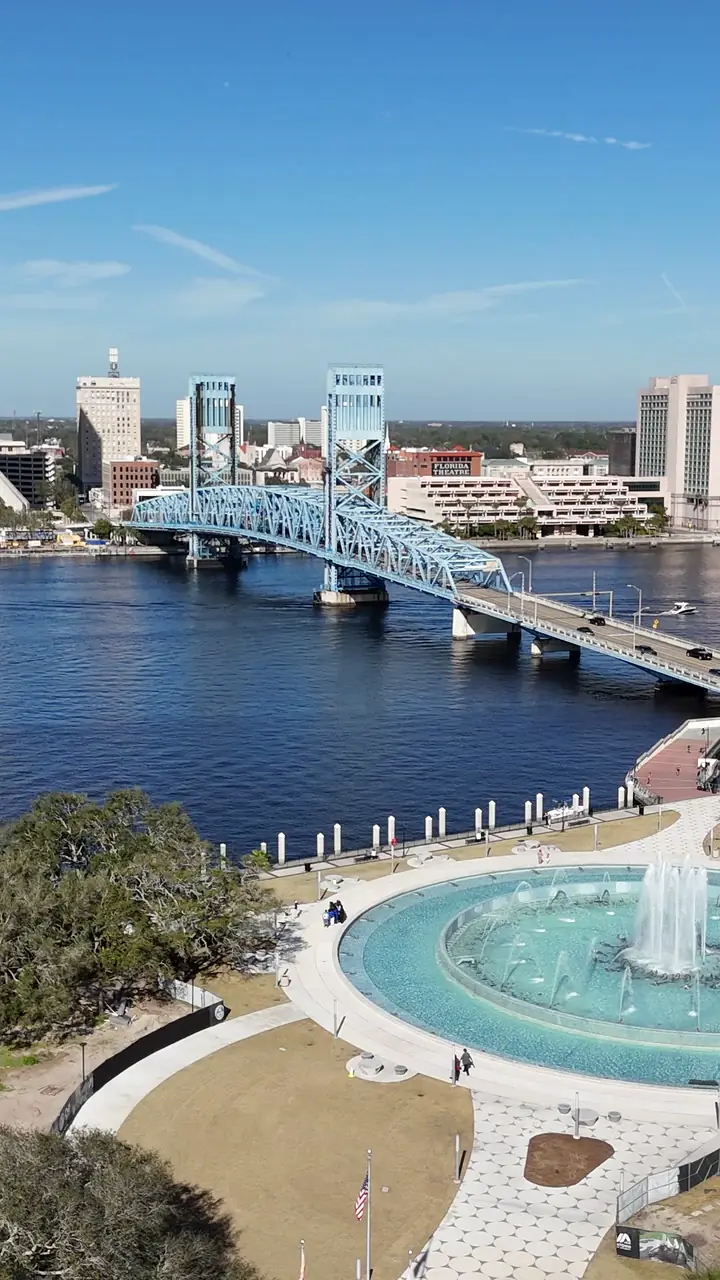
Commercial Property Insurance in Jacksonville, St. Augustine and Northeast Florida
Commercial property insurance for Jacksonville and St. Augustine businesses combines building, business personal property, business-interruption and hurricane/wind coverage, which we shop across 40+ A-rated Florida carriers. The premium here turns on the hurricane deductible the carrier filed, a separate flood policy sized against the $500,000 federal cap, the protection class, and a current replacement-cost limit on older building stock.
Commercial property insurance for Jacksonville, St. Augustine and the First Coast: building, contents, wind and flood. Free proposal from 40+ carriers.
Figures reviewed against Florida Statutes and carrier bulletins on September 27, 2026.
Commercial property insurance in Jacksonville (Duval County)
Jacksonville buildings are priced on four things a board or owner can actually see: the hurricane deductible the carrier filed, whether flood is on a separate policy, the protection class, and the age of the building stock.
- Florida's hurricane-deductible menu ($500, 2%, 5% or 10%) is written into law for residential policies only (FS 627.701(3)); on a commercial building the percentage the carrier files is the one that applies. On a $2 million building a 5% deductible is $100,000 before the policy pays, and 2% is $40,000. A deductible buy-back policy closes that gap.
- Flood is a separate policy, and the river is the exposure: the St. Johns crested at a record 5.57 feet at Main Street during Irma on September 11, 2017, with about 350 water rescues, most in Riverside, San Marco and downtown. Federal (NFIP) commercial coverage stops at $500,000 for the building and $500,000 for contents, and it never includes business income.
- Jacksonville holds FEMA Community Rating System Class 6, a 20% discount on federal flood premiums, and JFRD is ISO Class 1, the best fire-protection class a property underwriter can price.
- Downtown, Riverside and Springfield carry 1850–1949 building stock that rebuilds at today's cost under the 2023 Florida Building Code; replacement cost and ordinance-or-law coverage are the two numbers to re-run at every renewal.
- The market turned in 2026: Florida commercial property premiums averaged 16.6% lower in March 2026 than a year earlier, and Citizens' commercial non-residential rates changed on July 1, 2026 (multiperil down 1.8%, wind-only down 5.0%). Citizens holds only 4 multiperil and 9 wind-only non-residential policies in Duval, so a Jacksonville building is priced by private carriers that are competing again.
- Two Florida rules that apply to every commercial policy: catastrophic ground cover collapse must be covered and sinkhole loss must be offered (FS 627.706), and if a carrier fails, the state guaranty fund caps a covered commercial claim at $300,000 (FS 631.57), which is why carrier financial strength is part of the placement.
Commercial property insurance in St. Augustine (St. Johns County)
St. Johns County has grown 26.7% since 2020, and its commercial stock runs from coquina and masonry in the nation's oldest city to new construction along the SR 207 corridor. The two ends of that range are insured very differently.
- Flood discounts are set by community, not county: St. Augustine moved to CRS Class 4 in April 2026, a 30% discount on federal flood premiums; unincorporated St. Johns County is Class 5 at 25%; St. Augustine Beach is Class 8 at 10%.
- Matthew pushed about two and a half feet of water across Anastasia Island and over the Castillo de San Marcos seawall in October 2016, and Nicole sent water down Avenida Menendez in November 2022. Neither storm made landfall in Northeast Florida. By the city's own estimate, tidal 'sunny day' flooding puts water in low-lying downtown streets 12 to 16 times a year, peaking during the fall king tides.
- The city anticipates finishing the Avenida Menendez seawall rehabilitation by the marina by October 31, 2026, weather permitting, and its Lake Maria Sanchez stormwater project will add a pump station, a flood wall and tide check valves to protect roughly 200 acres of the historic downtown. Until those are done, business income coverage is what keeps payroll paid when the street floods, and federal flood policies never include it.
- St. Augustine's historic district is full of coquina buildings, a soft shell limestone, some dating to the 1700s. Repairing coquina walls is specialized masonry work; in our placements many standard carriers decline these buildings without a specialist market, and the replacement-cost estimate has to reflect the masonry, not a strip-center rebuild figure.
- St. Augustine's fire department is ISO Class 1; the county rates properties Class 3, 3X or 10 by distance to a station and a hydrant, and that class shows up directly in the premium.
- Citizens holds 4 multiperil and 2 wind-only non-residential policies in the county as of July 31, 2026, so the private market sets the price here too.
- Growth is the other exposure: on August 19, 2026 the county certified two agricultural enclaves of roughly 615 and 550 acres near I-95 and SR 207 for development, which means years of builders risk, vacant-building and lessor's-risk placements on the corridor.
The Northeast Florida commercial property map, county by county
| County | Flood-program (CRS) class → federal flood discount | Fire protection | Citizens non-residential policies, 7/31/26 |
|---|---|---|---|
| Duval | Jacksonville Class 6 → 20% | JFRD Class 1 | 4 multiperil, 9 wind-only |
| St. Johns | County Class 5 → 25%; St. Augustine Class 4 → 30%; St. Augustine Beach Class 8 → 10% | County 3 / 3X / 10 by distance; St. Augustine FD Class 1 | 4 multiperil, 2 wind-only |
| Clay | County Class 6 → 20% | Rated by distance to station and hydrant | 1 multiperil |
| Nassau | County Class 7 → 15%; Fernandina Beach Class 5 → 25% | Fernandina 3 / 3X | 1 wind-only |
| Flagler | County Class 6 → 20%; Palm Coast Class 4 → 30% | Palm Coast 2.0 | 2 multiperil, 5 wind-only |
| Putnam | County Class 8 → 10% | Not published | None |
| Baker | County Class 10 → no discount | Not published | None |
Commercial property guides
- How to Lower Commercial Property Insurance in Duval County: The 2026 Market Guide
- Is Your Jacksonville Business Sitting on a $250,000 Hurricane Deductible? How a Deductible Buyback Works
- St. Augustine Commercial Insurance in 2026: Historic-District Flood, Coquina Replacement Cost, and the Business-Interruption Gap
- Florida Commercial Property Insurance for SBA Loans: Replacement Cost, Wind, and Deductibles
Data sources
- FEMA, NFIP Community Status Book (Community Rating System classes)
- National Weather Service Jacksonville, Hurricane Irma post-storm summary
- National Weather Service Jacksonville, Hurricane Matthew event summary
- City of Jacksonville, public safety dashboard (JFRD ISO Class 1)
- City of St. Augustine, ISO Class 1 rating
- City of St. Augustine, Lake Maria Sanchez Stormwater Project
- City of St. Augustine, resiliency and infrastructure project update (April 7, 2026)
- City of St. Augustine, City-Wide Tide Check Valves (tidal flooding frequency)
- FEMA / NFIP, non-residential coverage limits
- Citizens Property Insurance Corporation, 2026 Rate and Rule Changes (April 30, 2026)
- American Coastal Insurance Corporation, Form 8-K, May 5, 2026 (Florida commercial property market pricing)
- Florida Statutes § 627.701 (hurricane deductibles)
Frequently Asked Questions
What does commercial property insurance cover?
Commercial property insurance covers your business building, equipment, inventory, furniture and fixtures against fire, theft, vandalism, wind, hail and other covered perils. It includes the structure if you own it, improvements and betterments if you rent, and can include business interruption coverage for lost income during repairs. It does not cover floods, earthquakes or normal wear and tear.
How much does commercial property insurance cost?
There is no single Florida number. The price is built from the building's replacement cost, construction and roof age, the fire-protection class, distance to the coast, the hurricane deductible percentage, the flood zone and your community's CRS class, occupancy, and claims history. An independent broker can turn those details into a real range from 40+ carriers.
What is business interruption insurance and do I need it?
Business interruption coverage, also called business income, replaces lost income and covers ongoing expenses when your business must close due to a covered loss like fire or storm damage. It pays for lost profits, rent, payroll and other fixed costs while you rebuild or relocate. Most businesses should carry it.
Do I need commercial property insurance if I rent my business space?
Yes! Even if you rent, you need commercial property insurance to cover your business contents (equipment, inventory, furniture, computers) and any improvements you made to the space (renovations, built-ins, fixtures). Your landlord's insurance only covers the building structure—not your business property. Most commercial leases require tenants to carry property insurance and name the landlord as an additional insured.
What's the difference between replacement cost and actual cash value coverage?
Replacement cost coverage pays to replace damaged property with new items at current market prices, with no deduction for depreciation. Actual cash value pays replacement cost minus depreciation, so you receive less for older items. If a 5-year-old computer is destroyed, actual cash value pays only what the old computer was worth. Replacement cost costs more.
How big is the hurricane deductible on a Jacksonville commercial building?
Whatever percentage the carrier filed. Florida's $500, 2%, 5% and 10% hurricane-deductible menu applies to residential policies under FS 627.701(3), not to commercial property, so a Jacksonville or St. Augustine building owner has to negotiate it. On a $2 million building, a 5% named-storm deductible is $100,000 out of pocket before the policy pays and 2% is $40,000.
What is a hurricane deductible buy-back policy?
A deductible buy-back policy converts a percentage named-storm deductible into a flat retention you can budget. On a $2 million building, a 5% named-storm deductible is $100,000 out of pocket before the policy pays and 2% is $40,000.
Does commercial property insurance cover flooding in St. Augustine's historic district?
No. Commercial property policies exclude flood, so a separate flood policy is required. Federal (NFIP) commercial coverage stops at $500,000 for the building and $500,000 for contents and never includes business income, so a downtown restaurant or shop needs private excess flood and separate business-interruption coverage.
Does St. Augustine get a flood insurance discount?
Yes. Inside St. Augustine city limits the flood premium carries a 30% Community Rating System discount (Class 4 since April 2026). Unincorporated St. Johns County earns 25%.
Are commercial property insurance rates in Jacksonville going down in 2026?
Yes, for most buildings. Florida commercial property premiums averaged 16.6% lower in March 2026 than a year earlier, according to the state's largest admitted commercial-residential writer. Citizens' commercial non-residential rates changed on July 1, 2026, with multiperil down 1.8% and wind-only down 5.0%. AM Best expected reinsurance costs to fall further at the June 2026 renewals.
Related Guides
- Check your fleet's risk with the free DOT Risk Scorecard
- How to lower commercial property insurance in Duval County
- Florida commercial insurance rates in 2026: business owner's guide
- The Jacksonville hurricane-deductible buyback playbook
- Does commercial property insurance cover hurricanes in Florida?
- St. Augustine commercial insurance: historic-district flood and coquina replacement cost
- Commercial property insurance for SBA loans: replacement cost, wind and deductibles
- Estimate your building's replacement cost with the Florida commercial property calculator
Get a free quote or call (904) 900-5063 — Atesa Risk Advisors, independent Florida insurance brokerage.