The Disney Host's Insurance Bible: Protecting Your Kissimmee STR in 2026
By Ricardo Alonso, Founder, Atesa Risk Advisors · May 3, 2026
Key Takeaways
- Disney-corridor short-term rentals in Osceola and Polk counties carry roughly 2x to 3x the bodily-injury exposure of an average Florida vacation home because of high-density family groups, themed amenities, and constant pool use [1].
- Florida Statute 515.27 already requires an 85 dB exit alarm on every door and window with direct pool access — and as of 2026, Florida property carriers are demanding photo proof at renewal before binding STR coverage [2].
- Airbnb's AirCover commonly excludes custom-built furniture (themed bunk beds, tree-house lofts, slide-in-bed rooms) when the host can't produce a safety certification — leaving a six-figure liability gap on a typical Reunion or Encore villa [3].
- Hosts in Osceola County (Kissimmee, Celebration) typically pay roughly 10–15 % more for liability than identical Polk County properties (Davenport, ChampionsGate) due to social-inflation pressure on jury awards under HB 837 [4].
- Disney World has closed for at least eight named storms since 2004; AirCover pays $0 for "amenity-loss" cancellations, while a commercial STR policy with Business Income coverage replaces missed bookings dollar for dollar [5].
If you host a 4-to-10-bedroom villa anywhere inside the Disney Corridor, your default Airbnb / Vrbo coverage is almost certainly leaving you exposed. The combination of themed amenities, year-round pool use, large family groups, and Florida's post-HB 837 liability climate has pushed underwriters to a new 2026 standard — and AirCover is not it. This is the playbook that "Power Hosts" running Reunion, Encore, ChampionsGate, Windsor Hills, Solara, and Margaritaville Resort properties are using to close the gap.
The Disney Corridor — Osceola and Polk counties — is one of the densest concentrations of professionally operated short-term rentals in the United States. Many of these homes are no longer "vacation homes that occasionally rent." They are full-time hospitality businesses with eight bedrooms, themed game rooms, private splash pools, and 200-plus turnover nights per year. Florida's insurance market has caught up to that reality, and so has Florida's regulatory environment.
The result: in 2026, the policy you bought in 2022 is probably not what you actually need.
Disney Corridor Alert — May 2026
If you host in Osceola or Polk County, your risk profile is roughly 2x to 3x higher than the average Florida host. The "Disney Effect" brings high-density family groups, themed amenities, and constant pool usage. As of May 2026, failing to display your DBPR vacation-rental license number in your listing or missing the 85 dB pool exit-alarm standard under Florida Statute 515.27 can trigger an immediate "Non-Compliance" insurance denial that AirCover will not defend [2][6].
From Star Wars to Princesses: Is Your Custom Bunk Bed Actually Covered?
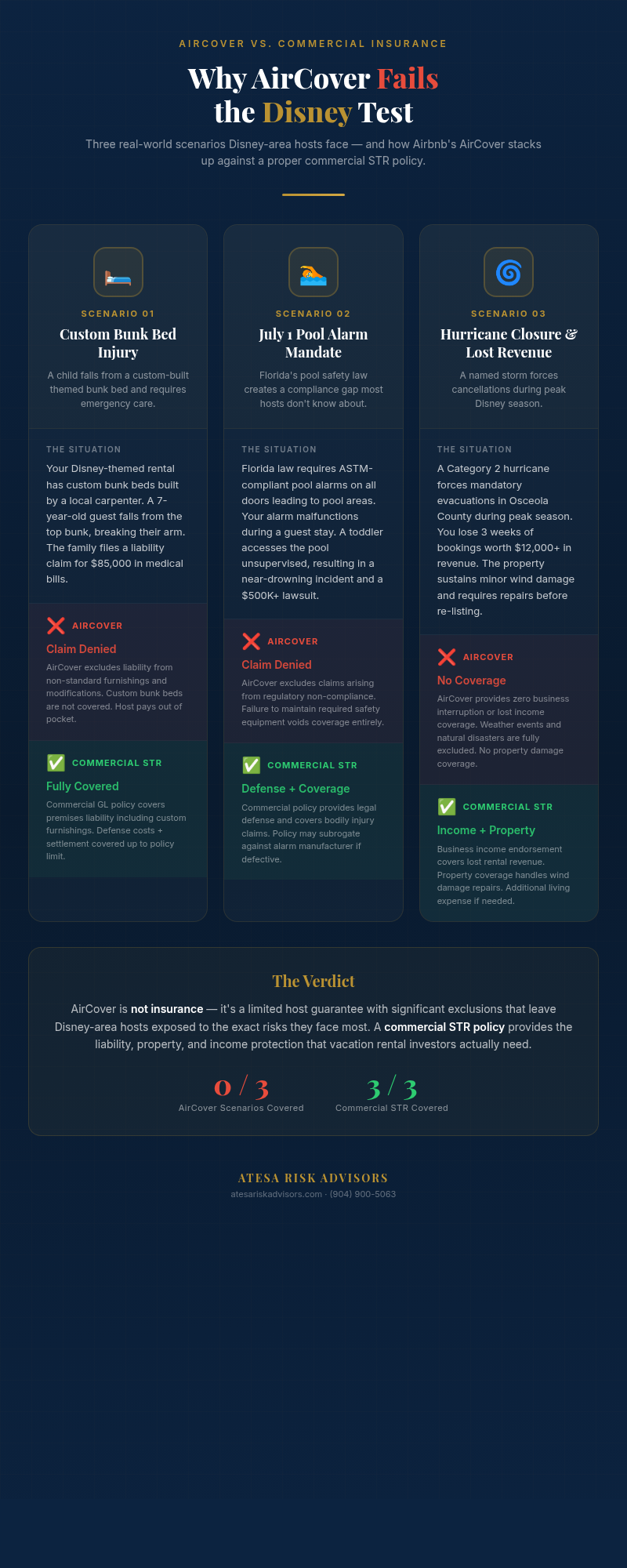
Walk into any 5-bedroom villa in Encore Resort or Windsor Hills and you'll find at least one room built around a brand. Star Wars-themed pods. Princess castle bunk beds. Avengers-style splash pools. Frozen-themed loft beds with built-in slides. A custom bunk-bed build for a single themed room routinely costs $10,000 to $20,000 in materials and labor.
That investment is exactly where AirCover — Airbnb's Host Damage Protection program — falls down.
AirCover's terms exclude liability for custom-built or altered furniture that the host cannot prove was professionally manufactured to a recognized safety standard (ASTM, CPSIA, or commercial-furniture grade) [3]. A four-year-old falls from the top bunk of an unsafetied custom build at 2 a.m. The parents file a claim. AirCover's investigation finds:
- No bunk-bed safety rail certification on file
- Custom build with non-standard rail height
- No professional installation invoice
Result: AirCover declines the host's defense. The family's attorney pivots to a direct premises-liability claim against the LLC that owns the property — and the case settles in the high six figures.
The 2026 fix: a Themed Amenity Rider. Several commercial STR carriers now offer endorsements that specifically schedule custom interior builds (themed bunk rooms, slide installations, escape rooms, themed home theaters) as covered property and provide named-amenity liability defense, provided the host documents:
- A licensed contractor or installer for any built-in furniture that supports a child's weight
- ASTM F1427 or equivalent safety-rail compliance for elevated sleeping surfaces
- Annual photo inspection submitted at renewal
If you're hosting in Reunion or ChampionsGate and you have themed rooms but no scheduled-amenity coverage, that's the single most expensive gap on your policy.
The July 1st Countdown: Pool Alarms and the Kissimmee Villa
Most Disney-corridor villas — particularly in Windsor Hills, ChampionsGate, Solara, and Margaritaville Resort — have private pools with direct interior access through sliding glass doors or French doors leading to the lanai.
Florida's Residential Swimming Pool Safety Act, codified at Florida Statute 515.27, has required for years that residential pools with direct interior access doors include an exit alarm with a minimum sound pressure level of 85 decibels at 10 feet on every door and window providing access to the pool [2]. The statute is not new. What's new is enforcement.
Three things changed in 2025–2026:
- Florida property carriers added pool-alarm photo verification to their renewal underwriting. Several major STR-friendly markets now require a date-stamped photo of each installed alarm before they will bind or renew the policy.
- Negligence claims under HB 837's modified comparative-negligence framework are punishing non-compliant pools. A drowning or near-drowning at a host's pool where the alarm wasn't installed, wasn't powered, or wasn't tested moves the case from "tragic accident" to "willful disregard of statute" — a deliberate-act bucket that most policies will not defend [4].
- Florida's 2026 legislative session considered tightened pool-safety legislation (track the latest at leg.state.fl.us) further hardening renewal requirements, with a July 1 effective date for any tighter standard.
The practical 2026 underwriting standard for a Disney-area pool home is now:
- 85 dB exit alarm on every door and window with direct pool access
- Self-latching/self-closing devices on the same openings
- Either a 4-foot child barrier (statute compliant) or an approved automatic pool safety cover
- A written, dated alarm-test log submitted at renewal
If you can't produce the photo at renewal, expect either non-renewal or a 25–40 % premium load. If a claim hits before you fix it, you are deep in Wilful Negligence territory — which is a death blow to liability defense.
AirCover vs. Commercial STR Policies: 2026 Coverage Benchmark
Many Disney-corridor hosts are still relying on AirCover plus a standard HO-3 homeowners policy. That stack does not survive a serious claim. Here is how the two coverage models actually compare for a typical Power Host scenario.
| Coverage Item | AirCover (Airbnb default) | HO-3 + Endorsement | Commercial STR Policy |
|---|---|---|---|
| Per-occurrence liability | $1,000,000 (limited triggers) | Often denied for STR use | $1M–$5M, no STR exclusion |
| Custom/themed amenities | Excluded without certification | Excluded as "business use" | Scheduled & insured |
| Pool-related bodily injury | Limited (assumes statute compliance) | Often excluded post-HB 837 | Defended w/ statute-compliant install |
| Loss of Income from hurricane | $0 | $0 | 12 months Business Income |
| Loss of Income from Disney closure | $0 | $0 | Optional Civil Authority |
| Guest theft of host property | Up to $3M (subject to investigation) | Generally excluded | Included w/ tenant deposit |
| Building & contents | Not covered | Often denied for STR use | Replacement-cost basis |
| DBPR / license-noncompliance defense | Excluded | Excluded | Excluded — but flagged for fix |
Notice the second-to-last row. No insurance product will defend you against operating without a valid Florida DBPR vacation-rental license [6]. Every Disney-corridor host should display the DBPR license number in the listing description and inside the home. A missing license is the easiest fact for a plaintiff's attorney to prove.
Location Matters: Davenport (Polk) vs. Kissimmee (Osceola) Insurance Costs
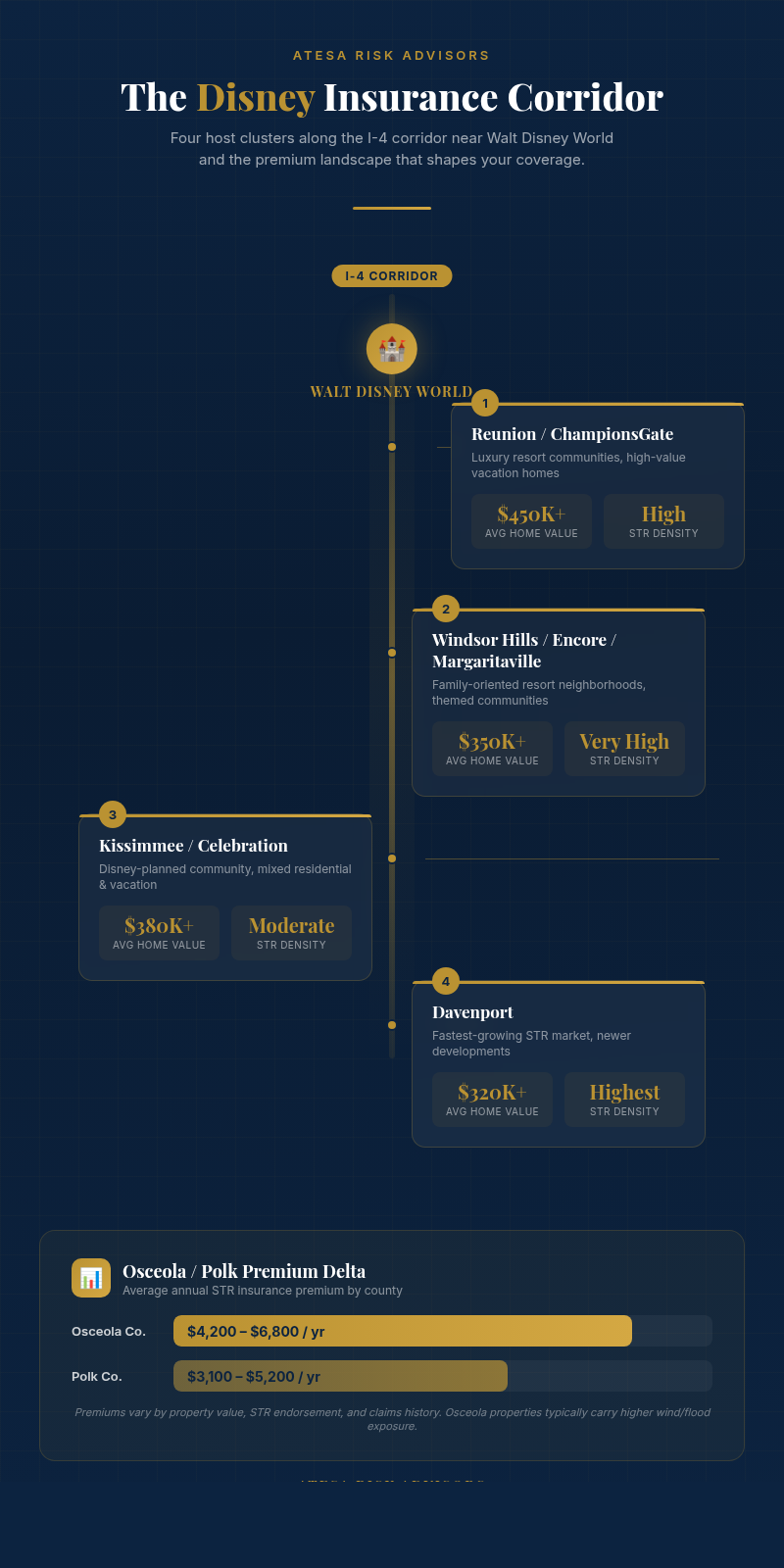
The single most underestimated rating variable on a Disney-corridor STR is which side of the Osceola–Polk county line you sit on. The drive from Reunion to ChampionsGate is fifteen minutes. The insurance math is not. If you own a rental on the Osceola side, our Kissimmee vacation rental insurance guide walks through the local coverage picture in more detail.
Osceola County (Kissimmee, Celebration, Reunion, Encore, Windsor Hills)
- Stricter local noise and occupancy enforcement on STRs
- Heavier court calendars in Florida's 9th Judicial Circuit, with measurable social inflation in jury awards on bodily-injury cases [4]
- Florida HB 837's 2-year statute of limitations on negligence still applies, but the size of awards inside this circuit has trended higher
- Net effect on premium: typically 10–15 % higher liability rates than an identical home five miles west
Polk County (Davenport, ChampionsGate, Solara, Margaritaville Resort)
- More lenient zoning posture toward STR operation in unincorporated areas
- Slightly lower jury-award averages on premises liability
- But: Polk County sits inside the highest flash density corridor in the United States. Florida is the lightning capital of the country, and Polk County reliably tops the per-square-mile charts year over year [7]
- Net effect: lower base liability premium but materially higher contents/electronics replacement-cost rating, and a separate lightning-surcharge load on policies that include a high-end home-theater, smart-home, or arcade build-out
A simplified way to think about the lightning surcharge a Disney-corridor carrier may apply to a Polk County game-room-heavy build:
$\text{Lightning Surcharge} = \text{Base Property Rate} \times (\text{Flash Density Index} \times \text{Electronic Replacement Value})$
The "Flash Density Index" is the carrier's published per-zip-code multiplier; the "Electronic Replacement Value" is the documented dollar value of insured electronics (theaters, arcades, golf simulators, smart-home systems). On a heavily themed Solara villa, the lightning surcharge alone can run $400 to $1,200 a year — but it can also save you from a five-figure surge claim that AirCover would never touch.
From the field
Most Disney Corridor hosts I meet are paying for an HO-3 plus AirCover and assume that's the same as commercial coverage. Six months later they have a pool incident, a themed-room incident, or a hurricane that closes Disney for a week — and they discover what they actually bought. The 2026 fix is to move to a real STR policy, fix the FS 515.27 alarm gap, and document the DBPR license inside the home and inside the listing. That stack is what survives a claim.
— Ricardo Alonso, Founder, Atesa Risk Advisors
Florida-Specific Considerations
Three Florida statutes shape every Disney-corridor STR insurance program in 2026.
- Florida Statute 509.013(4)(a)1 — Defines a "vacation rental" as any unit licensed as transient public lodging not classified as a hotel, motel, or timeshare. If you rent for periods under 30 days more than three times in a calendar year, you fall under this definition and you owe a DBPR license [6].
- Florida Statute 515.27 — The Residential Swimming Pool Safety Act. Mandates the 85 dB exit-alarm standard, 4-foot barrier alternative, or approved safety cover. Non-compliance is the single most cited factor in declined liability claims involving children [2].
- Florida HB 837 (2023) — Tort reform. Reduced the negligence statute of limitations from 4 years to 2 years and codified modified comparative negligence (a plaintiff more than 50 % at fault recovers nothing). HB 837 is genuinely good news for Disney-corridor hosts — but only when paired with documented compliance. Without alarms and a DBPR license, the modified-comparative defense weakens [4].
For the actual statute text, search leg.state.fl.us/Statutes. For verification of property zoning in your jurisdiction, the Osceola County Property Appraiser (property-appraiser.org) and Polk County Tax Collector (polktaxes.com) maintain free public-record lookups for any Disney-corridor address.
Your 5-Step 2026 Disney Corridor Compliance Timeline
Hosts who close all five gaps below before the next renewal cycle typically save 12–25 % vs. the renewal load they would otherwise face — and far more than that on the first claim that hits.
| Step | What You Do | Why It Matters | Time |
|---|---|---|---|
| 1 | Pull your DBPR license number and confirm the listing description shows it on Airbnb / Vrbo | A missing license is the easiest fact a plaintiff can prove | 15 min |
| 2 | Walk every door and window with direct pool access. Photograph each 85 dB alarm with a date overlay | Underwriters now require this at renewal under FS 515.27 | 30 min |
| 3 | Inventory every custom-built or themed amenity (bunk beds, slides, theaters, arcades) with replacement value and any safety certification | Triggers Themed Amenity Rider eligibility | 1 day |
| 4 | Pull last 12 months of bookings revenue. This becomes your Business Income limit | Without it, hurricane / Disney-closure income loss is $0 | 1 hour |
| 5 | Replace AirCover-only stack with a commercial STR policy that schedules amenities, names FS 515.27 compliance, and includes Business Income | Closes every gap above in one bind | 1–2 weeks |
The full timeline from "decision to fix" to "policy bound" is typically 14–21 days for a Disney-corridor villa, faster if your DBPR license and pool-alarm photos are already in hand.
Frequently Asked Questions for Disney Area Hosts
Q: Does my insurance cover damage from "themed" amenities like home theaters or arcades?
A: Only if the amenity is scheduled on a commercial STR policy as named property and the carrier knows about it. A standard HO-3 policy generally treats high-end themed builds as either business property (excluded) or unscheduled personal property (subject to a low contents sub-limit). A themed home theater or arcade in a Solara or Margaritaville villa needs to be itemized at replacement cost, with the carrier on notice of its commercial use.
Q: I have a "grandfathered" vacation-rental license in Kissimmee — does that lower my insurance?
A: No. A grandfathered DBPR license affects local zoning permission to operate, not insurance pricing. What it does change is replacement value: a grandfathered home in a residential zone where new STRs cannot be permitted is worth materially more than the same home in a freely permitted zone. Make sure your dwelling limit is set on Extended Replacement Cost (typically 125–150 % of the dwelling limit) so that a total loss does not leave you under-insured against current rebuild prices.
Q: What happens to my income if Disney World closes for a hurricane?
A: AirCover pays $0. A standard HO-3 pays $0. A commercial STR policy with Business Income and an optional Civil Authority extension pays you for the missed bookings during a covered closure period. Disney World has closed for at least eight named storms since 2004 — Charley, Frances, Jeanne, Wilma, Matthew, Irma, Ian, and Milton — and most closures last 1 to 4 days, with some occupancy disruption stretching 2 to 3 weeks for the surrounding corridor [5]. On a 4-bedroom villa booked at average Disney-corridor ADRs, that recovered income alone usually pays the entire annual premium of the upgraded policy.
Q: Does Florida HB 837 actually help short-term rental hosts?
A: Yes — but only if you're documented. HB 837's modified-comparative-negligence rule means a guest who is more than 50 % responsible for their own injury recovers nothing. To use that defense, you need contemporaneous records: signed house rules, FS 515.27-compliant pool features, a posted DBPR license, and evidence the guest was on notice of the pool, balcony, or themed amenity. Hosts who haven't built that paper trail can't capture HB 837's benefit when a claim lands [4].
Q: I host through both Airbnb and Vrbo — is AirCover enough if I add Vrbo's Liability Insurance program?
A: No. Airbnb's AirCover and Vrbo's Liability Insurance are both designed as secondary coverage that activates after the host's own commercial coverage. They are not full replacements. Both programs include exclusions for unscheduled custom amenities, certain pool incidents, and any business-income loss. Treat them as a useful complement, not the foundation.
Q: What's the cheapest legitimate way to insure a Disney Corridor 5-bedroom villa in 2026?
A: A commercial STR policy with $1M per-occurrence liability, $2M aggregate, replacement-cost dwelling, scheduled themed amenities, and Business Income — bundled with a $1M Excess Liability layer. On a typical 5-bedroom Reunion or Encore villa with a private pool and themed rooms, the bundled stack runs $4,500–$8,500 a year depending on claim history, location, and electronic-amenity value. That is meaningfully more than HO-3 + AirCover, and meaningfully less than the cost of a single uninsured pool or themed-amenity claim.
Q: Do I need separate workers' compensation for my cleaning crew and pool tech?
A: If you're directly hiring, almost always yes — Florida's threshold is low for non-construction employees, and even a 1099 cleaner working under your direction can trigger statutory employer status. If you use a licensed cleaning company that carries its own workers' comp, request a Certificate of Insurance naming you as Certificate Holder on every renewal and store it with the property file.
Q: Why does my Florida-based agency mention Spanish and Portuguese support — does that matter?
A: For the Disney Corridor, yes. Roughly half the investor base in Reunion, Encore, Solara, and Margaritaville Resort is Brazilian or Latin American. Closing a coverage gap on a Power Host portfolio often requires reading 30 pages of policy language and a half-dozen claim letters in the owner's primary language. Atesa Risk Advisors works with hosts in English, Spanish, and Portuguese specifically because it's a Disney Corridor reality, not a marketing line.
Download: Disney Guest Safety Card (Bilingual EN / ES)
Print this letter-size, laminate-ready safety card and post it on the refrigerator inside your Kissimmee, ChampionsGate, Reunion, Encore, Windsor Hills, Solara, or Margaritaville villa. The bilingual layout (English / Español) covers the DBPR license posting, the Florida Statute 515.27 pool-alarm verification box, fire extinguisher locations marked in both languages, emergency contacts (911 / Disney Resort Security / Osceola and Polk Sheriff non-emergency), and a clean house-rules summary that reflects current 2026 underwriting expectations.
Download the Disney Guest Safety Card (English / Español) →
Related Reading
- The AirCover Illusion: 5 Critical Gaps in Airbnb’s Host Protection (2026 Edition) — Topic-focused deep dive on the five structural gaps in AirCover that drive nearly every six-figure short-term rental loss in Florida.
- The Florida Second Home Airbnb Guide: Protect Your Property (and Your Policy) in 2026 — The companion guide for occasional second-home hosts in Naples, Sarasota, and Marco Island who rent through HO-3 plus an STR endorsement instead of a full commercial policy.
- Does Commercial Property Insurance Cover Hurricanes in Florida? The 2026 Reality Check — The companion piece on what hurricane and Business Income coverage actually pays when Disney shuts down.
- 5 Insurance Mistakes Florida Business Owners Make (And How to Avoid Them) — Three of the five mistakes show up disproportionately in Disney-corridor STR portfolios.
- Florida Commercial Insurance Rates in 2026: A Complete Guide for Business Owners — How Disney-corridor STR rates compare to the broader Florida commercial market.
How Atesa Risk Advisors Can Help
Atesa Risk Advisors is an independent Florida insurance brokerage that specializes in commercial-grade short-term rental coverage for Disney Corridor hosts. We shop more than 40 A-rated carriers, hold direct appointments with several STR-friendly markets that don't sell direct to consumers, and we read every policy line by line before we recommend it. We also work with hosts in English, Spanish, and Portuguese.
If you operate in Reunion, Encore, ChampionsGate, Windsor Hills, Solara, or Margaritaville Resort, we will pull your current declarations page, walk your property's themed amenities and pool, confirm DBPR and FS 515.27 compliance, and quote a 2026 stack that closes the gaps above. There is no cost to the analysis and no obligation to bind.
Are you a Reunion or ChampionsGate owner who wants a Disney Corridor Gap Analysis on your existing policy? Get your free quote and consultation at atesariskadvisors.com/get-quote or call (904) 900-5063.
Sources
[1] AirDNA & VRMA short-term rental market reports for the Orlando–Kissimmee–Sanford MSA, citing density of Disney-corridor active listings vs. statewide vacation-rental averages. AirDNA Market Trends, Orlando MSA. https://www.airdna.co/
[2] Florida Statute 515.27 — Residential Swimming Pool Safety Act, including the 85 dB exit-alarm provision for doors and windows providing direct pool access. https://www.leg.state.fl.us/Statutes/index.cfm
[3] Airbnb AirCover for Hosts — program terms and exclusions, including limitations on coverage for custom-built or altered furnishings without recognized safety certification. https://www.airbnb.com/aircover-for-hosts
[4] Florida House Bill 837 (2023) — Civil Remedies / Tort Reform, modifying comparative-negligence framework and reducing the negligence statute of limitations from four to two years. https://www.flsenate.gov/Session/Bill/2023/837
[5] National Hurricane Center, NOAA — Atlantic hurricane archive documenting Florida storm impacts including Disney World operational closures for Charley (2004), Frances (2004), Jeanne (2004), Wilma (2005), Matthew (2016), Irma (2017), Ian (2022), and Milton (2024). https://www.nhc.noaa.gov/data/
[6] Florida Department of Business and Professional Regulation (DBPR) — Vacation rental licensing requirements under Florida Statutes Chapter 509. https://www.myfloridalicense.com/DBPR/hotels-restaurants/
[7] National Weather Service — Florida lightning climatology and per-county flash-density data identifying Polk County as a top per-square-mile flash density region. https://www.weather.gov/safety/lightning
[8] Insurance Information Institute (III) — Short-term rental and home-sharing insurance considerations. https://www.iii.org/article/insurance-for-home-sharing-services
External Resources for Disney Corridor Hosts:
- Osceola County Property Appraiser — public record lookup for parcel, zoning, and value verification
- Polk County Tax Collector — vacation-rental local-business-tax registration
- Florida DBPR Vacation Rental Licensing — initial and renewal licensing portal
- Florida Statutes — searchable index — primary text for FS 509, FS 515, HB 837
Ricardo Alonso is the Founder of Atesa Risk Advisors, a Florida independent insurance agency. Licensed 2-20 General Lines Agent and 2-15 Health & Life Agent, with a Master of Liberal Arts in Finance from Harvard University. Atesa Risk Advisors specializes in Disney Corridor short-term rental coverage and works with Power Hosts in English, Spanish, and Portuguese across Reunion, Encore, ChampionsGate, Windsor Hills, Solara, and Margaritaville Resort.