The AirCover Illusion: 5 Critical Gaps in Airbnb's Host Protection (2026 Edition)
By Ricardo Alonso, Founder, Atesa Risk Advisors · May 3, 2026 · Updated July 7, 2026
Key Takeaways
- Airbnb's AirCover is structured as a discretionary host guarantee, not a regulated insurance product — Airbnb retains sole discretion over claim approval and is not bound by Florida's Insurance Code chapters 626 and 627 [1][8].
- Loss of income from hurricanes, civil-authority closures, or local infrastructure damage is not covered; AirCover only pays for booking interruptions caused by direct guest damage to your property [1].
- AirCover liability protection is generally tied to the insured location — if your guest crashes a host-provided golf cart, kayak, or e-bike off-premises, the program will likely deny the claim. A commercial STR policy can extend Off-Premises Amenity Liability for these scenarios [2][6].
- Even when AirCover pays a settlement, it does not provide a Duty to Defend — meaning no defense attorney is automatically assigned to you when a guest sues. In 2026 Florida, legal fees alone routinely exceed $50,000 before trial begins [4][8].
- Florida's 85 dB pool-exit-alarm requirement under Florida Statute 515.27 is now an underwriting requirement at carrier renewal — and AirCover's "host follows local laws" requirement turns any non-compliance into grounds for denial [3][5].
If you list a Florida property on Airbnb and you think AirCover is a substitute for insurance, you have five expensive gaps to close before your next booking. AirCover is a useful supplemental program — Airbnb's marketing is not wrong about that — but it is structured as a corporate guarantee under Airbnb's terms of service, not as a regulated insurance contract under Florida law. The difference matters in five specific scenarios that hit Florida hosts disproportionately.
This is the gap-by-gap breakdown that Florida hosts, property managers, and short-term-rental investors should run through before every renewal cycle.
This post focuses on the gaps themselves. For the full coverage architecture for Disney Corridor Power Hosts running themed villas, see The Disney Host's Insurance Bible: Protecting Your Kissimmee STR in 2026. For occasional second-home hosts in Naples, Sarasota, or Marco Island, see The Florida Second Home Airbnb Guide.
2026 Florida Risk Summary
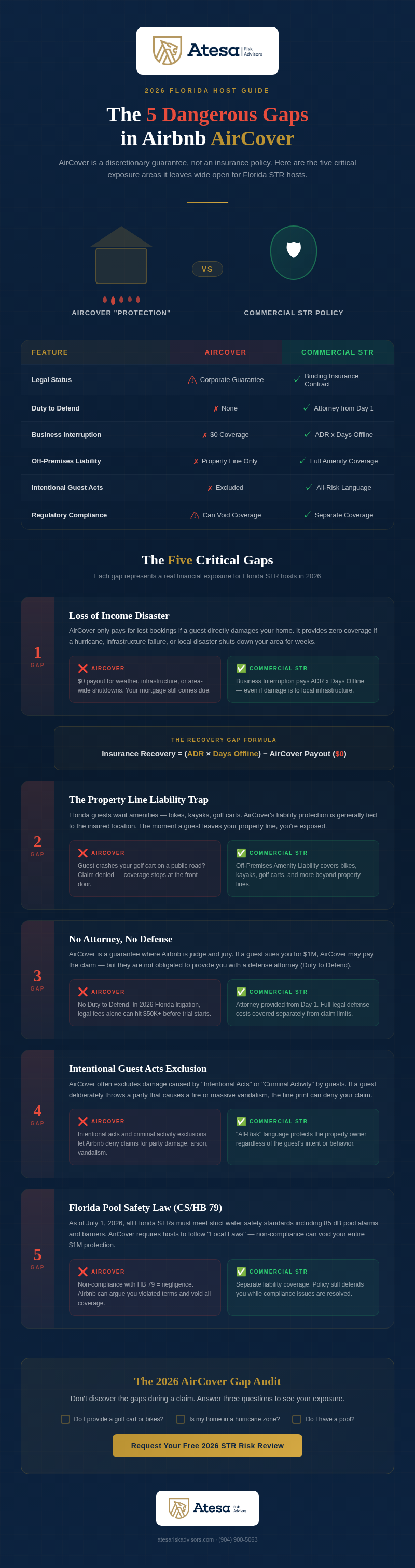
Airbnb AirCover is a discretionary guarantee, not an insurance policy. In Florida's 2026 regulatory environment AirCover leaves hosts exposed in five major areas: Loss of Income (outside of guest damage), Off-Premises Liability, Legal Defense Costs, Intentional Acts by Guests, and Regulatory Non-Compliance (including the Florida Statute 515.27 pool-safety mandate enforced at every renewal in 2026) [1][3][8].
Gap 1: AirCover Won't Pay Your Mortgage After a Hurricane
The most expensive gap is also the most easily missed. AirCover only triggers a booking-interruption payout when a guest directly damages your property — when the home itself becomes unrentable because of damage caused by a paying guest [1]. Every other source of unrentability is excluded.
That includes the four most common Florida disruption events:
- A hurricane damages your roof or pool cage and bookings cancel for repairs
- A civil-authority order (mandatory evacuation, road closures) prevents guests from arriving
- Local infrastructure damage — a downed bridge, power-grid outage, or municipal water shutdown — keeps guests away even though your home is fine
- Disney World closes for a Cat-2 hurricane and 12 paid bookings cancel through the Airbnb platform
In all four cases, AirCover pays $0 in lost-income recovery. The math on a typical Florida 4-bedroom STR in any of these scenarios:
$\text{Insurance Recovery} = (\text{ADR} \times \text{Days Offline}) - \text{AirCover Payout (\$0)}$
For a $475-ADR Florida STR offline for 21 days after a Category 2 storm, that's a $9,975 income loss with zero recovery from AirCover.
The commercial alternative. A short-term rental policy with a Business Income endorsement and an optional Civil Authority extension pays you for the income loss during a covered closure period — even when the damage is to local infrastructure rather than to your home itself. Most Florida-market commercial STR forms include a 12-month Business Income limit and a 4-week Civil Authority sub-limit [2][6].
Gap 2: Your Liability Ends at the Property Line
Florida hosts compete on amenities. Bikes. Kayaks. Stand-up paddleboards. Golf carts. Pontoon rentals. E-bikes for the beach. Even a shared neighborhood pool fob.
AirCover liability protection is generally tied to the insured location — meaning the protection assumes the incident happened on the property. The terms include language that excludes liability arising from off-premises activities and excludes claims related to vehicles operated by guests [1].
The scenarios where this trips up Florida hosts:
- Guest in Davenport crashes a host-provided golf cart on a public road. AirCover denies. Florida HB 837 modified-comparative-negligence calculus does not apply because there is no underlying carrier defending the claim.
- Guest renting a 30A beach house capsizes a host-provided kayak in the Gulf and loses an iPhone. AirCover denies the lost property and any claimed injury.
- Guest at a Naples waterfront launches a host-provided paddleboard, has a shoulder injury, and the host receives a demand letter for medical expenses. AirCover declines.
The commercial alternative. A 2026 commercial STR policy can endorse Off-Premises Amenity Liability as a named coverage extension, naming each amenity the host provides (golf cart, kayak, paddleboard, e-bike) on the policy schedule with appropriate per-occurrence limits. Several Florida-market STR carriers will write this for $200–$600 per amenity per year — a fraction of the cost of a single off-premises injury claim [2].
Gap 3: You Have a Guarantee, But You Don't Have a Lawyer
This gap is the most expensive and the least understood.
In Florida insurance law, the Duty to Defend is a separate obligation from the duty to pay claims. A liability insurance policy issued under Florida Insurance Code chapters 626 and 627 obligates the carrier to provide an attorney from the moment a covered claim is filed — long before a settlement is paid, and regardless of whether the claim ultimately has merit [8].
AirCover does not provide a Duty to Defend. Because AirCover is structured as a host-protection guarantee under Airbnb's terms of service rather than as a regulated insurance contract, Airbnb is the judge and jury on every claim. If a guest sues you for $1 million for an alleged injury at your Florida property, the program's terms allow Airbnb to evaluate the claim and pay a settlement at its discretion — but they are not obligated to assign you a defense attorney [1][8].
In 2026 Florida litigation, the practical implication is significant:
- Average legal fees on a defended Florida premises-liability matter exceed $50,000 before trial begins
- HB 837's 2-year statute of limitations means hosts have less time to retain counsel and assemble defenses
- Without a Duty-to-Defend trigger, hosts pay these legal fees out of pocket while AirCover evaluates whether to pay anything at all [4]
The commercial alternative. A commercial STR liability policy includes Duty to Defend language as a matter of statute. The carrier's panel attorney appears within days, defense costs are paid outside the per-occurrence liability limit (so you don't burn your $1M policy paying lawyers), and any settlement is paid by the carrier — not by you while AirCover deliberates.
Gap 4: When "Bad Guests" Do "Bad Things" On Purpose
Vandalism. Drug-fueled parties. Intentional fire-setting. Theft.
AirCover's terms include exclusions for damage caused by intentional acts or criminal activity by guests, with Airbnb retaining sole discretion to determine whether a particular incident qualifies [1]. The program's marketing emphasizes the $3 million Host Damage Protection limit, but the fine print carves out the most expensive incident type a Florida host actually faces.
The scenarios Florida hosts have run into:
- Guest hosts an unauthorized 80-person party at a Kissimmee pool home that spirals into a kitchen fire
- Guest deliberately destroys themed bedroom furnishings in an Encore Resort villa over a refund dispute
- Guest steals high-value electronics, jewelry, and art that were not in a locked owner closet
- Guest causes deliberate water damage by leaving multiple faucets running for days
The commercial alternative. Most Florida-market commercial STR policies use all-risk coverage language for property damage, which protects the named insured (the host) regardless of whether the cause was negligent, accidental, or intentional on the guest's part. Liability against the guest is then a separate matter for subrogation; the host is paid first and the carrier pursues recovery against the guest. This is the single largest functional difference between AirCover and a commercial STR policy on a typical Florida claim profile.
Gap 5: The 2026 Florida Pool Safety Compliance Gap
This is the gap that quietly converts a pool-related claim from "covered" to "denied."
Florida Statute 515.27 — the Residential Swimming Pool Safety Act — requires every residential pool with direct interior access to include an exit alarm with a minimum sound pressure level of 85 decibels at 10 feet on every door and window providing direct pool access. The statute is not new; what is new is that as of 2026, Florida property carriers are requiring date-stamped photo proof of installation at every renewal, and AirCover's terms specifically condition the program on the host complying with all applicable laws and regulations [1][3].
The compliance gap unfolds like this:
- Guest's child has a near-drowning incident at the host's Florida pool home
- Investigation finds the 85 dB exit alarm was missing, disabled, or untested
- AirCover's evaluators determine the host was non-compliant with FS 515.27 ("local laws")
- AirCover declines coverage on the grounds of host negligence and regulatory non-compliance
- Guest's family files directly against the host. Without a Duty to Defend on AirCover, the host is now exposed personally and pays defense costs out of pocket while the case proceeds [3][4]
For Florida hosts in 2026, the practical compliance standard is now:
- 85 dB exit alarm on every door and window with direct pool access (FS 515.27)
- Date-stamped renewal photo of each installed alarm in the property file
- Self-latching/self-closing devices on all pool-access openings
- Either a 4-foot child barrier (statute compliant) or an approved automatic pool safety cover
- A written, dated alarm-test log retained with the property file
A non-compliant pool turns every potential claim into a deniable claim.
AirCover (Guarantee) vs. Commercial STR Policy (Insurance Contract)
The structural difference between AirCover and a Florida commercial STR policy is not a marketing distinction — it is a regulatory one. The two products are governed by completely different bodies of law.
| Attribute | AirCover (Discretionary Guarantee) | Commercial STR Policy (Insurance Contract) |
|---|---|---|
| Regulatory framework | Airbnb terms of service | Florida Insurance Code Chapters 626, 627 |
| Issuing entity | Airbnb (corporate program) | A-rated insurance carrier admitted in Florida |
| Coverage mechanism | Discretionary payment | Contractual obligation |
| Duty to Defend | No | Yes (built into the form) |
| Loss of Income (non-guest cause) | Excluded | Business Income endorsement |
| Hurricane / civil authority | Excluded | Civil Authority extension |
| Off-premises amenity liability | Tied to insured location | Schedulable rider |
| Intentional acts by guests | Often excluded | Covered under all-risk forms |
| Statutory non-compliance | Voids coverage | Carrier defends; subrogates against responsible party |
| Claim adjudicator | Airbnb | The carrier (regulated by FOIR) |
| Disputed-claim recourse | Limited | Florida Department of Financial Services complaint process |
A Florida host who relies solely on AirCover is operating without a regulated insurance contract. A host who layers a commercial STR policy underneath AirCover gets the best of both — Airbnb's discretionary first-dollar guarantee on small guest-damage claims plus a real insurance contract for the five gaps above.
The 2026 AirCover Gap Audit
Run this audit against your current Florida STR setup. Each "yes" is a confirmed gap that AirCover alone will not cover.
| # | Question | Gap if YES |
|---|---|---|
| 1 | Do you provide a golf cart, bike, kayak, or paddleboard to guests? | Off-premises amenity liability |
| 2 | Is your home in a hurricane zone or coastal flood zone? | Loss of income from civil authority / infrastructure |
| 3 | Do you have a pool? | FS 515.27 compliance + pool-incident defense |
| 4 | Have you been on an Airbnb listing for more than 12 months? | Cumulative wear-and-tear claims AirCover may dispute |
| 5 | Do you allow more than 6 guests at any time? | Party / vandalism risk — intentional-acts exclusion |
| 6 | Do you have any custom-built or themed furniture? | Custom-furniture exclusion under AirCover terms |
| 7 | Have you ever had a claim denied by AirCover? | History of disputed coverage |
| 8 | Is your Florida DBPR vacation-rental license current and displayed? | Regulatory non-compliance gap (Gap 5) |
A score of 3 or more "yes" answers means the cost of a single denied claim exceeds the annual premium of a commercial STR policy by an order of magnitude. Most Disney-corridor and coastal Florida hosts hit 5 or more.
Download: AirCover vs. Reality Checklist
Print this letter-size, fillable audit and run it against your current AirCover setup. Sheet 1 is the Guarantee vs. Insurance structural comparison (what AirCover is, what it isn't, and what each program is regulated by). Sheet 2 is the 2026 Florida Host Self-Audit — eight Yes/No questions that map directly onto the five gaps above plus three Florida-specific compliance items.
Download the AirCover vs. Reality Checklist →
From the field
I read AirCover's terms cover-to-cover at every renewal cycle for our Florida STR clients. The 2026 version still excludes the five categories I just walked through, plus a few more we can absorb into the commercial form for under $1,000 a year on a typical 4-bedroom Florida vacation home. The hosts who get hurt are the ones who treat AirCover as a substitute for an insurance policy. AirCover is a useful complement to a real STR contract — never a replacement for one.
— Ricardo Alonso, Founder, Atesa Risk Advisors
Florida-Specific Considerations
Five Florida-specific rules shape every AirCover-host conversation in 2026.
- Florida Insurance Code Chapter 626 — Defines what counts as an "insurance contract" in Florida and which entities may issue them. AirCover, as a corporate guarantee program, is not regulated under Chapter 626 [8].
- Florida Insurance Code Chapter 627 — Codifies the Duty to Defend obligation on liability carriers. AirCover's terms do not assume this obligation [1][8].
- Florida Statute 515.27 — Residential Swimming Pool Safety Act, including the 85 dB exit-alarm provision that triggers the AirCover compliance gap [3].
- Florida Statute 509.013(4)(a)1 — Vacation rental classification. Renting more than 3 times per year for under-30-day stays triggers DBPR licensure, which AirCover requires hosts to maintain [5].
- Florida HB 837 (2023) — Tort reform with 2-year negligence statute of limitations and modified comparative-negligence rule. Helps documented hosts and hurts undocumented ones [4].
Statute text: leg.state.fl.us/Statutes. DBPR licensing portal: myfloridalicense.com [5]. Florida insurance market data: Florida Office of Insurance Regulation [7].
Your 5-Step AirCover Gap Closure Timeline
Hosts who close all five gaps below before their next renewal typically save 12–25 % vs. the renewal load they would otherwise face after the first denied AirCover claim.
| Step | What You Do | Why It Matters | Time |
|---|---|---|---|
| 1 | Read AirCover's current terms and identify each of the 5 gaps that apply to your property | Most hosts have 3–5 gaps and don't know it | 30 min |
| 2 | Pull last 12 months of bookings revenue. This becomes your Business Income limit | Without it, hurricane / civil-authority loss is uninsured | 1 hour |
| 3 | If you have a pool, photograph each 85 dB exit alarm with a date overlay (FS 515.27) | Carrier renewal requirement + AirCover compliance gap | 30 min |
| 4 | Inventory every host-provided amenity (golf cart, bikes, kayaks, paddleboards) and document VIN/serial where applicable | Triggers Off-Premises Amenity Liability eligibility | 1 day |
| 5 | Bind a commercial STR policy that names FS 515.27 compliance, schedules amenities, and includes Business Income + Duty to Defend | Closes all 5 gaps in one bind | 1–2 weeks |
The full sequence from "decision to fix" to "policy bound" is typically 14–21 days for a Florida STR property.
Frequently Asked Questions for Florida Airbnb Hosts
Q: Is AirCover insurance?
A: No. AirCover is a discretionary host-protection guarantee under Airbnb's terms of service. It is not a regulated insurance product under Florida Insurance Code chapters 626 or 627, and Airbnb retains sole discretion over claim adjudication. A regulated insurance carrier admitted in Florida operates under contractual obligations enforced by the Florida Office of Insurance Regulation [1][8].
Q: Will AirCover pay my mortgage if a hurricane shuts down my Florida STR?
A: No. AirCover's booking-interruption coverage triggers only when a guest directly damages your property. Hurricane damage, civil-authority closures, and local infrastructure damage are excluded from the program. A commercial STR policy with a Business Income endorsement and Civil Authority extension covers these scenarios [1][2].
Q: If a guest crashes my golf cart on a public road, will AirCover cover it?
A: Almost certainly no. AirCover liability protection is generally tied to the insured location and the program's terms exclude claims related to vehicles operated by guests. Off-Premises Amenity Liability is a named endorsement on a commercial STR policy that schedules each amenity the host provides [1][2].
Q: Does AirCover provide me with a defense attorney if a guest sues me?
A: No. AirCover does not include a Duty to Defend obligation. If a guest sues, you retain and pay your own defense counsel until and unless AirCover decides to settle. In 2026 Florida litigation, defense costs alone typically exceed $50,000 before trial. Commercial STR liability policies include Duty to Defend with defense costs paid outside the per-occurrence limit [4][8].
Q: What does AirCover cover if a guest intentionally vandalizes my home or throws an unauthorized party?
A: AirCover's terms include exclusions for damage caused by intentional acts and criminal activity by guests, with Airbnb retaining sole discretion. The most expensive STR loss types — large-scale vandalism, deliberate fires, theft of unsecured owner property, intentional water damage — fall into this carve-out. Commercial STR policies use all-risk coverage that protects the host regardless of the guest's intent [1][2].
Q: Why does the Florida pool-alarm law (FS 515.27) matter to my AirCover coverage?
A: AirCover's terms condition the program on the host complying with all applicable laws. Florida Statute 515.27 requires an 85 dB exit alarm on every door and window with direct pool access. If a pool incident occurs and an investigation finds the alarm was missing, disabled, or untested, AirCover can decline coverage on the grounds of host negligence and regulatory non-compliance — and there is no underlying carrier with a Duty to Defend backing you up [1][3].
Q: Can I keep AirCover and add a commercial STR policy?
A: Yes — and this is the right answer for most Florida hosts. AirCover is useful as a discretionary first-dollar layer on small guest-damage claims (broken TV, stained sofa, hosting a missing-item dispute). A commercial STR policy sits underneath as the regulated insurance contract that covers the five structural gaps above. Treat AirCover as a complement, not a foundation.
Q: How much does a commercial STR policy cost on a typical Florida 4-bedroom vacation home?
A: For a 4-bedroom Florida coastal or Disney-corridor STR with $1.4M dwelling value, $1M per-occurrence liability, replacement-cost dwelling, scheduled amenities, Business Income, and Off-Premises Amenity Liability: typical 2026 premiums run $4,500 to $7,500 per year. That is meaningfully more than AirCover-only, and meaningfully less than the cost of a single denied claim under any of the five gaps [2][7].
Related Reading
- Amelia Island Short-Term Rental Insurance in 2026: Permits, the City-County Line, and the Coverage Gap Most Hosts Miss — How Fernandina Beach permits, the city-county line, and barrier-island wind and flood risk shape what a Northeast Florida host actually needs.
- The Disney Host's Insurance Bible: Protecting Your Kissimmee STR in 2026 — The full coverage architecture for Disney Corridor Power Hosts running themed villas in Reunion, Encore, ChampionsGate, Windsor Hills, Solara, and Margaritaville.
- The Florida Second Home Airbnb Guide: Protect Your Property (and Your Policy) in 2026 — The HO-3 endorsement vs. DP-3 vs. commercial-hybrid playbook for occasional second-home hosts in Naples, Sarasota, Marco Island, and 30A.
- Does Commercial Property Insurance Cover Hurricanes in Florida? The 2026 Reality Check — The companion piece on Business Income coverage and what hurricane payouts actually look like.
How Atesa Risk Advisors Can Help
Atesa Risk Advisors is an independent Florida insurance brokerage that specializes in commercial-grade short-term rental coverage across Florida — Disney Corridor villas, second-home coastal properties, urban condos, and waterfront homes. We shop more than 40 A-rated carriers, hold direct appointments with several STR-friendly markets that don't sell direct to consumers, and we read every line of AirCover's terms against the underlying state insurance law before recommending a stack. We also work with hosts in English, Spanish, and Portuguese.
If you list any Florida property on Airbnb or Vrbo, we will pull your current declarations page, run the AirCover Gap Audit on your specific property type and location, and quote a 2026 commercial STR policy that closes the five gaps above. There is no cost to the analysis and no obligation to bind.
Don't find the gaps during a claim. Upload your policy for a 2026 STR Risk Review. Get your free quote and consultation at atesariskadvisors.com/get-quote or call (904) 900-5063.
Sources
[1] Airbnb AirCover for Hosts — program terms, exclusions, and Host Damage Protection requirements. https://www.airbnb.com/aircover-for-hosts
[2] Insurance Information Institute (III) — Insurance for home-sharing and short-term rental hosts; coverage gap analysis. https://www.iii.org/article/insurance-for-home-sharing-services
[3] Florida Statute 515.27 — Residential Swimming Pool Safety Act, including the 85 dB exit-alarm provision for doors and windows providing direct pool access. https://www.leg.state.fl.us/Statutes/index.cfm
[4] Florida House Bill 837 (2023) — Civil Remedies / Tort Reform, including modified comparative negligence and the 2-year statute of limitations on negligence. https://www.flsenate.gov/Session/Bill/2023/837
[5] Florida Department of Business and Professional Regulation (DBPR) — Vacation rental licensing requirements under Florida Statutes Chapter 509. https://www.myfloridalicense.com/DBPR/hotels-restaurants/
[6] National Association of Insurance Commissioners (NAIC) — Home-sharing and short-term rental insurance considerations. https://content.naic.org/insurance-topics/sharing-economy
[7] Florida Office of Insurance Regulation (FOIR) — Florida property and STR insurance market reports. https://floir.com/
[8] Florida Insurance Code, Chapters 626 (Insurance Field Representatives and Operations) and 627 (Insurance Rates and Contracts) — defining what constitutes a regulated insurance contract in Florida. https://www.leg.state.fl.us/Statutes/index.cfm
External Resources for Florida Airbnb Hosts:
- Florida DBPR Vacation Rental Licensing — initial and renewal licensing portal
- Florida Statutes — searchable index — primary text for FS 509, FS 515, HB 837
- Insurance Information Institute — Home-Sharing — industry-neutral overview of host coverage options
- Airbnb AirCover for Hosts — official program terms (read carefully before relying on them)
Ricardo Alonso is the Founder of Atesa Risk Advisors, a Florida independent insurance agency. Licensed 2-20 General Lines Agent and 2-15 Health & Life Agent, with a Master of Liberal Arts in Finance from Harvard University. Atesa Risk Advisors specializes in commercial-grade short-term rental coverage for Florida hosts and reviews Airbnb's AirCover terms against the underlying state insurance law at every client renewal. The firm works with hosts in English, Spanish, and Portuguese.